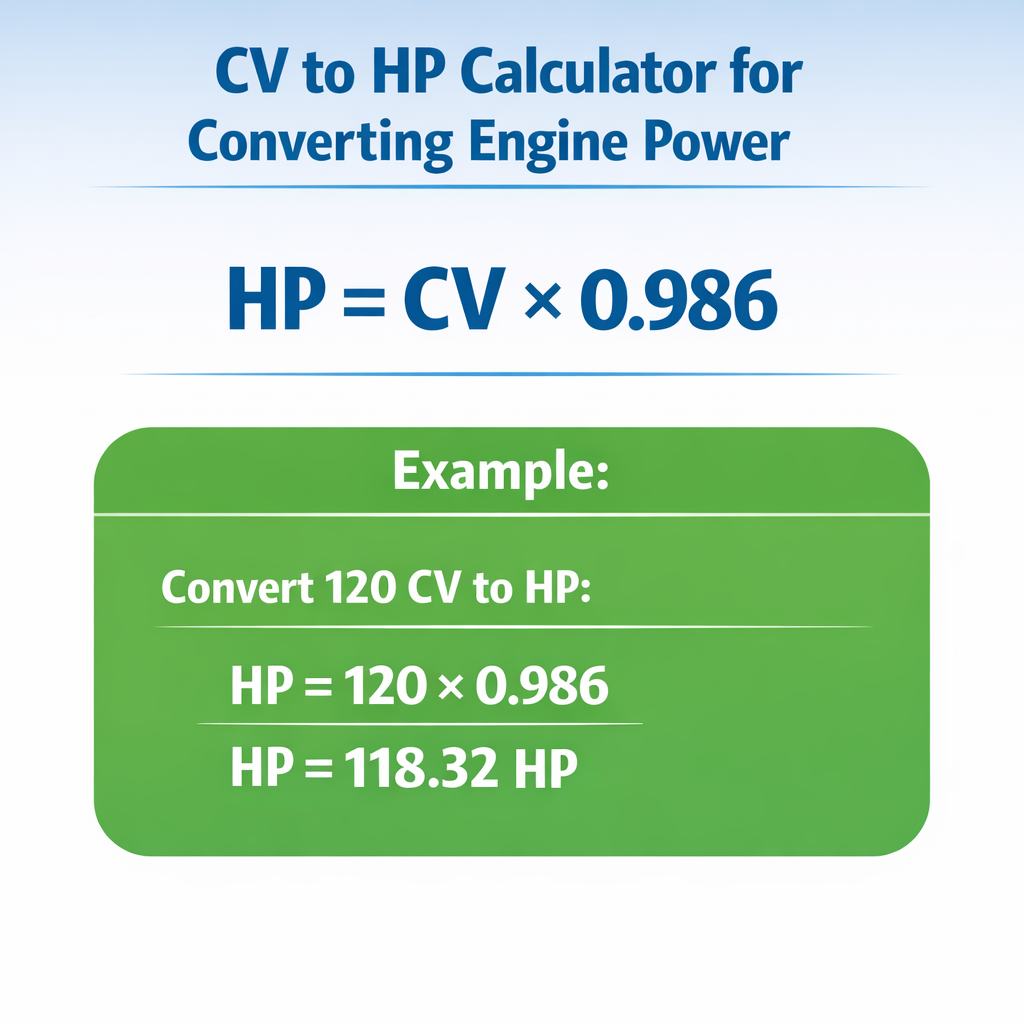
HP = CV × 0.98632 · CV = HP × 1.01387 · 1 CV = 735.499 W · 1 HP = 745.700 WQuick Reference Table
| CV | HP | kW |
|---|---|---|
| 100 | 98.63 | 73.55 |
| 150 | 147.95 | 110.32 |
| 200 | 197.26 | 147.10 |
| 300 | 295.90 | 220.65 |
| 500 | 493.16 | 367.75 |
| 800 | 789.06 | 588.40 |
| 1000 | 986.32 | 735.50 |
FAQ
Are CV and PS the same?
Yes. CV (French) and PS (German) both mean metric horsepower = 735.499 W.
Is BHP the same as HP?
In most automotive contexts, yes. BHP (brake horsepower) is HP measured at the crankshaft.
If you are comparing car specs across continents, importing European machinery, or cross-referencing motor datasheets, you need a reliable CV to HP calculator. CV (cheval-vapeur) is the metric horsepower used in France, Spain, Italy, Germany (as PS), and most of Asia and Latin America. HP (mechanical horsepower) is the standard in the United States, Canada, and the UK. The two units are close — 1 CV = 0.98632 HP — but the 1.37% difference adds up on a 500+ CV engine and matters for regulatory compliance, insurance classification, and motor sizing.
This page gives you an instant three-way converter (CV ↔ HP ↔ kW), the exact formulas with worked examples, a comprehensive conversion table, and direct answers for every popular CV value — from 110 CV city cars to 1200 CV supercars.
CV to HP Conversion Table — Automotive & Industrial Sizes
This table covers the engine and motor ratings you will encounter in real spec sheets. CV is converted to both mechanical HP and kilowatts. The “Typical Vehicle / Application” column helps you find your row quickly.
| CV (PS) | HP (mech) | kW | Typical Vehicle / Application |
|---|---|---|---|
| 65 | 64.11 | 47.81 | City car (Fiat 500, Renault Twingo) |
| 90 | 88.77 | 66.19 | Economy hatchback (Polo, Clio base) |
| 110 | 108.50 | 80.90 | Compact sedan (Golf 1.0 TSI, Corolla) |
| 150 | 147.95 | 110.32 | Mid-range sedan (Passat, Camry) |
| 190 | 187.40 | 139.74 | Sports sedan (3 Series 320i, A4) |
| 250 | 246.58 | 183.87 | Performance sedan (M340i, S4) |
| 300 | 295.90 | 220.65 | Sports car (Supra, Cayman) |
| 400 | 394.53 | 294.20 | Muscle car (Mustang GT, Camaro SS) |
| 500 | 493.16 | 367.75 | Supercar entry (Corvette Z06, M5) |
| 620 | 611.52 | 455.81 | AMG GT, Ferrari Roma |
| 640 | 631.25 | 470.52 | Lamborghini Huracán |
| 666 | 656.89 | 489.63 | Ferrari 812 Competizione (base) |
| 725 | 715.08 | 533.24 | McLaren 720S |
| 800 | 789.06 | 588.40 | Bugatti Chiron class |
| 830 | 818.65 | 610.46 | Ferrari SF90 Stradale |
| 920 | 907.42 | 676.66 | Hybrid hypercar (AMG One) |
| 1000 | 986.32 | 735.50 | Bugatti Chiron Sport |
| 1200 | 1183.58 | 882.60 | Rimac Nevera, top-tier EV hypercar |
| 1500 | 1479.48 | 1103.25 | Bugatti Tourbillon |
Note: Automotive brochures in Europe list PS (identical to CV). Japanese datasheets also use PS. North American brochures list HP. When cross-shopping, use CV × 0.98632 to compare fairly.
Step-by-Step Formulas: CV to HP and kW
The conversion factor comes from the exact watt-equivalent of each unit. Metric horsepower (CV/PS) is defined as 75 kgf·m/s = 735.49875 W. Mechanical horsepower (HP) is defined as 550 ft·lbf/s = 745.69987 W. Dividing the first by the second gives you the conversion factor. These definitions are standardized in ISO 1000 and NEMA publications.
Formula 1 — CV to Mechanical HP
The factor 0.98632 = 735.49875 ÷ 745.69987. It means that 1 CV is slightly less than 1 HP — about 1.37% less.
Example: A Ferrari rated at 830 CV.
HP = 830 × 0.98632 = 818.65 HP.
Formula 2 — CV to kW
This factor is simply 735.49875 ÷ 1000. EU regulations (EC 715/2007) require engine power to be stated in kW for type-approval documents, even though marketing materials use CV/PS.
Example: 150 CV engine.
kW = 150 × 0.73550 = 110.32 kW.
Formula 3 — HP to CV (inverse)
The inverse factor is 1 ÷ 0.98632 = 1.01387. A 500 HP American muscle car is 507 CV in European terms.
Precision note
For engineering reports and regulatory filings, carry at least 5 significant figures: 0.98632 for CV→HP and 1.01387 for HP→CV. For quick mental math, just remember that CV and HP are nearly equal — the gap is under 1.4%. Per IEC 60034, official motor ratings should always reference kW as the SI unit, with CV or HP given as secondary notation.
CV vs HP vs PS vs BHP — What Is the Difference?
The automotive world uses at least four “horsepower” labels. They are not all the same, and confusing them leads to wrong comparisons and even insurance or regulatory issues. Here is the definitive comparison.
| Name | Symbol | Watts per Unit | Where Used | Origin |
|---|---|---|---|---|
| Cheval-vapeur | CV | 735.499 | France, Spain, Italy, Latin America | 75 kgf·m/s (metric system) |
| Pferdestärke | PS | 735.499 | Germany, Austria, Japan, Korea | Same as CV — German name |
| Mechanical HP | HP | 745.700 | USA, Canada, UK | 550 ft·lbf/s (James Watt) |
| Brake Horsepower | BHP | 745.700 | UK, Australia (automotive) | HP measured at crankshaft via dynamometer |
| Electric HP | HP(E) | 746.000 | N. America (electric motors) | Defined exactly as 746 W by IEC |
| Kilowatt | kW | 1000.000 | Worldwide (official SI unit) | SI base unit of power |
Key takeaway: CV = PS. They are interchangeable — just different languages for the same metric horsepower. BHP = HP in practice (both 745.7 W), but BHP specifically refers to brake dynamometer measurement. The only real conversion you need is CV ↔ HP, which is the 0.98632 factor.
Inverse Conversion: HP to CV
| HP (mech) | CV (PS) | kW | HP (mech) | CV (PS) | kW |
|---|---|---|---|---|---|
| 100 | 101.39 | 74.57 | 450 | 456.24 | 335.57 |
| 150 | 152.08 | 111.85 | 500 | 506.94 | 372.85 |
| 200 | 202.77 | 149.14 | 600 | 608.32 | 447.42 |
| 250 | 253.47 | 186.42 | 700 | 709.71 | 521.99 |
| 300 | 304.16 | 223.71 | 800 | 811.10 | 596.56 |
| 350 | 354.85 | 260.99 | 1000 | 1013.87 | 745.70 |
| 400 | 405.55 | 298.28 | 1500 | 1520.81 | 1118.55 |
You can use the calculator above — switch direction with the “HP → CV” button. For kW-based conversions, see our Amps to kW calculator.
6 Solved Examples — Real-World CV to HP Conversions
Example 1 — 110 CV Compact Car (VW Golf 1.0 TSI)
Data: Engine rated 110 CV (PS) per European spec sheet.
Formula: HP = 110 × 0.98632
Result: 108.50 HP (80.90 kW)
When a U.S. reviewer quotes this car as “109 HP,” they are rounding 108.50. The kW value (80.90) is what appears on the EU type-approval certificate.
Example 2 — 150 CV Mid-Range Sedan
Data: Diesel engine rated 150 CV.
Formula: HP = 150 × 0.98632
Result: 147.95 HP (110.32 kW)
The 150 CV / 148 HP rating is the sweet spot for European diesel sedans. Insurance companies in several EU countries calculate premiums partly based on CV — a 149 CV rating may place you in a cheaper bracket than 150 CV.
Example 3 — 640 CV Lamborghini Huracán
Data: V10 engine, 640 CV (official Lamborghini spec).
Formula: HP = 640 × 0.98632
Result: 631.24 HP (470.72 kW)
North American Lamborghini press releases quote “631 HP.” The 9 HP gap vs 640 CV is the conversion difference — not a different tune. When comparing against a Corvette Z06 at 670 HP, convert both to the same unit first.
Example 4 — 830 CV Ferrari SF90 Stradale
Data: Hybrid powertrain, 830 CV total system output.
Formula: HP = 830 × 0.98632
Result: 818.65 HP (610.46 kW)
Ferrari’s U.S. website lists “819 HP” — exactly our calculation rounded up. The 610 kW figure is used for EU CO₂ regulations and energy-label calculations.
Example 5 — 920 CV Hybrid Hypercar (AMG One)
Data: F1-derived powertrain, 920 CV.
Formula: HP = 920 × 0.98632
Result: 907.41 HP (676.66 kW)
At this power level, the 13 CV (12.6 HP) conversion gap is larger than many city car engines. Always specify which unit you are using in press comparisons.
Example 6 — 75 CV Industrial Motor (IEC Frame)
Data: IEC squirrel-cage motor rated 75 CV on a Spanish factory nameplate.
Formula: HP = 75 × 0.98632
Result: 73.97 HP (55.16 kW)
In Latin America and Southern Europe, motor nameplates often show CV instead of kW. A 75 CV motor is essentially a 75 HP (NEMA) motor — the 1 HP gap is within the standard tolerance. You can safely pair it with a 75 HP NEMA motor controller.
CV to HP in Electric Motors
While CV is primarily an automotive term, you will see it on motor nameplates in France, Spain, Portugal, Brazil, and several Asian countries. Here is how to handle it in an industrial context.
Nameplate Reads CV — Is It the Same as HP?
Almost, but not exactly. A motor stamped “5 CV” delivers 5 × 735.5 = 3677.5 W of shaft output. A motor stamped “5 HP” delivers 5 × 745.7 = 3728.5 W. The difference is 51 W — about 1.4%. In practice, motor efficiency tolerances per IEC 60034-30 are ±15% of the rated losses, which typically dwarfs the 1.4% CV/HP gap. So yes, for replacement purposes, a 5 CV motor and a 5 HP motor are interchangeable in nearly all cases.
When It Matters
The gap becomes significant on very large drives. A 500 CV motor delivers 367.7 kW; a 500 HP motor delivers 372.8 kW — a 5.1 kW difference. If you are programming a VFD with tight torque control (e.g., a paper winder or wire-drawing machine), enter the correct kW value from the nameplate, not a converted CV figure. Check our motor efficiency calculator for exact input/output figures by frame size.
CV on Brazilian and Argentinian Nameplates
In Brazil and Argentina, WEG and Siemens-NEMA motors use CV on the nameplate alongside kW. The IEC frame sizes are the same — only the power label changes. When ordering replacement parts from a NEMA catalog, convert CV to HP (× 0.98632) and round to the nearest NEMA standard size.
Quick Equivalences — Most-Searched CV to HP Values
These are the specific values people search for most, drawn from actual Google Search Console data. Each gives the direct answer plus automotive context.
110 CV to HP
108.50 HP · 80.90 kW
Compact cars: Golf 1.0 TSI, Corolla 1.6, Peugeot 308 base. Standard city/highway commuter.
150 CV to HP
147.95 HP · 110.32 kW
Mid-range diesels and small turbo-petrol engines (Passat 2.0 TDI, Mazda 3 2.0).
620 CV to HP
611.52 HP · 455.81 kW
High-performance GT class: AMG GT, Ferrari Roma, McLaren GT.
640 CV to HP
631.25 HP · 470.72 kW
Lamborghini Huracán V10. Often quoted as “631 HP” in U.S. media.
666 CV to HP
656.89 HP · 489.63 kW
Ferrari 812 Competizione base output. The iconic number makes this a popular search.
725 CV to HP
715.08 HP · 533.24 kW
McLaren 720S territory. Close to the NEMA 700 HP industrial motor frame.
800 CV to HP
789.06 HP · 588.40 kW
Hypercar class: Bugatti Chiron base, Koenigsegg Regera.
830 CV to HP
818.65 HP · 610.46 kW
Ferrari SF90 Stradale. U.S. listing rounds to 819 HP.
920 CV to HP
907.42 HP · 676.66 kW
Mercedes-AMG One F1-derived hybrid powertrain.
1200 CV to HP
1183.58 HP · 882.60 kW
Rimac Nevera, top-tier electric hypercar class. Also relevant for marine diesel engines.
CV to BHP
Same as CV to HP: BHP = CV × 0.98632
BHP (brake horsepower) and HP are mechanically identical (745.7 W). BHP simply specifies measurement at the crankshaft.
CV to kW
kW = CV × 0.73550
Required for EU type-approval documents (EC 715/2007). All official EU homologation uses kW.
Frequently Asked Questions
How do I convert CV to HP?
Multiply CV by 0.98632. Formula: HP = CV × 0.98632. Example: 300 CV × 0.98632 = 295.90 HP. The factor comes from dividing the watt-equivalent of CV (735.5 W) by HP (745.7 W).
Are CV and PS the same thing?
Yes, they are identical. CV is the French abbreviation (cheval-vapeur) and PS is the German abbreviation (Pferdestärke). Both equal 735.49875 watts. Japanese manufacturers also use PS.
What is the difference between CV and HP?
1 CV = 735.50 W; 1 HP = 745.70 W. CV is 1.37% smaller than HP. The difference arises from their definitions: CV uses metric units (75 kgf·m/s) while HP uses imperial units (550 ft·lbf/s).
Is BHP the same as HP?
In watt-equivalent terms, yes — both are 745.7 W. BHP (brake horsepower) specifies that the measurement was taken at the engine crankshaft using a dynamometer. HP can refer to any measurement point, but in automotive contexts it usually means the same as BHP.
How many HP is 150 CV?
147.95 HP. Calculation: 150 × 0.98632 = 147.95. This is equivalent to 110.32 kW. The 150 CV rating is extremely common for European mid-range diesel and turbo-petrol engines.
How many HP is 800 CV?
789.06 HP. Calculation: 800 × 0.98632 = 789.06. This is in the hypercar range — Bugatti Chiron base spec. The kW equivalent is 588.40.
How do I convert HP to CV?
Multiply HP by 1.01387. Formula: CV = HP × 1.01387. Example: 500 HP × 1.01387 = 506.94 CV. You can also use the calculator above — switch direction with the “HP → CV” button.
How do I convert CV to kW?
Multiply CV by 0.73550. Formula: kW = CV × 0.73550. Example: 200 CV × 0.73550 = 147.10 kW. The EU requires kW for official type-approval documents per EC 715/2007.
Why do European and American car specs show different HP numbers?
European specs use CV (metric HP), American specs use mechanical HP. A car rated 300 CV in Europe is listed as ~296 HP in the U.S. — not because the engine is different, but because the units are different. Always convert before comparing.
Does the CV to HP conversion apply to electric vehicles?
Yes. The math is the same regardless of the power source. A Rimac Nevera at 1914 CV = 1888 HP = 1408 kW. EV manufacturers increasingly list only kW, but marketing materials in Europe still use CV/PS for consumer familiarity.
Can I replace a motor rated in CV with one rated in HP?
In most cases, yes. The 1.37% difference is within standard motor manufacturing tolerances. A 10 CV motor (7.355 kW) and a 10 HP motor (7.457 kW) differ by only 102 W. Confirm that voltage, frequency, and frame dimensions match before swapping. See our Amps to HP calculator for current verification.
Where does the 0.98632 factor come from?
It is the ratio of the two watt-equivalents: 735.49875 W (1 CV) ÷ 745.69987 W (1 HP) = 0.986320. The metric value derives from 75 kgf × 1 m/s × 9.80665 m/s² = 735.49875 W. The imperial value derives from 550 ft × 1 lbf/s × 1.35582 = 745.69987 W.
Related Conversions
- Amps to HP Calculator — from current to horsepower
- Amps to kW Calculator — current to kilowatts
- Amps to Watts Calculator — single-phase and three-phase
- Motor Efficiency Calculator — IE class and efficiency lookup
- Amperes to VA Calculator — apparent power conversions
- Appliance Power Calculator — energy usage estimation