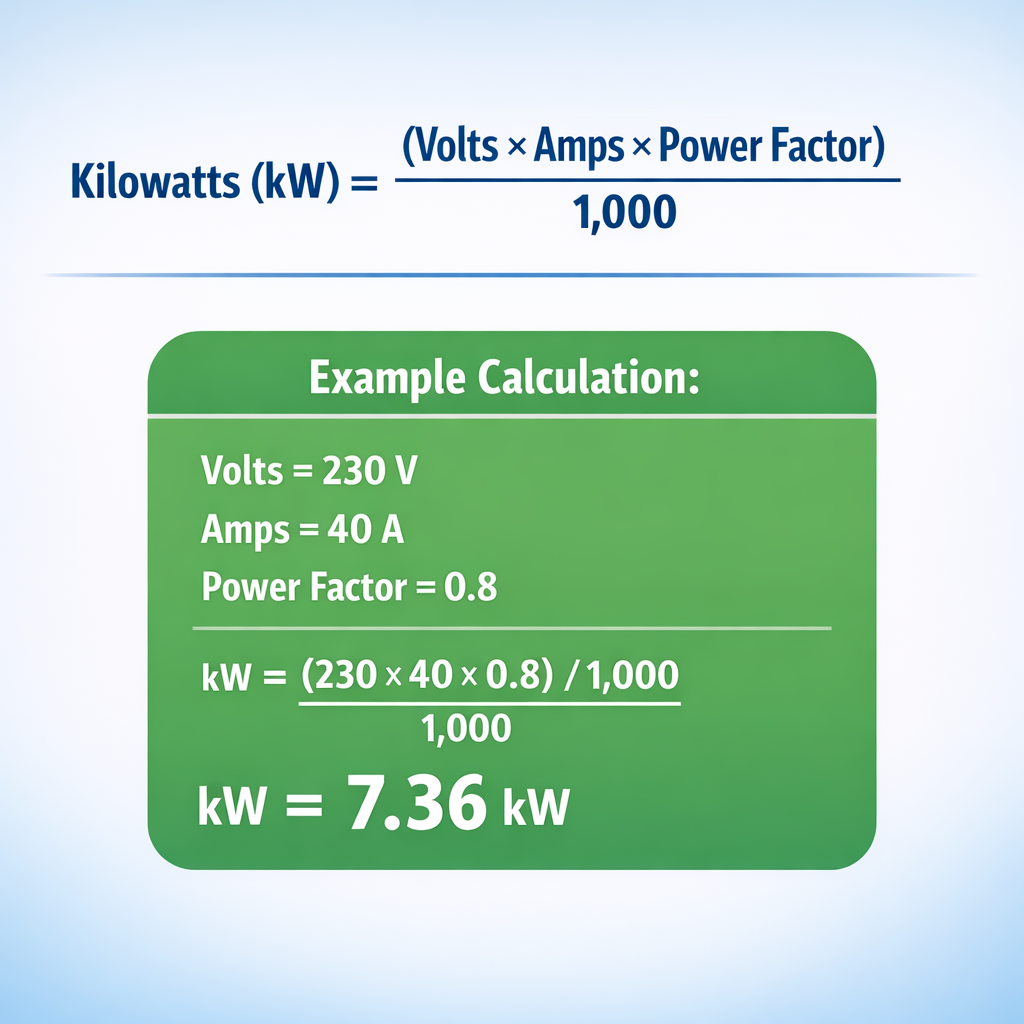
DC: kW = (V × A) ÷ 1000 · 1Φ AC: kW = (V × A × PF) ÷ 1000 · 3Φ AC: kW = (V × A × √3 × PF) ÷ 1000
📊 Quick Reference Table (120 V, PF 1.0)
| Amps | kW @120 V | kW @240 V | kW @480 V 3Φ |
|---|---|---|---|
| 5 | 0.60 | 1.20 | 4.16 |
| 10 | 1.20 | 2.40 | 8.31 |
| 15 | 1.80 | 3.60 | 12.47 |
| 20 | 2.40 | 4.80 | 16.63 |
| 30 | 3.60 | 7.20 | 24.94 |
| 50 | 6.00 | 12.00 | 41.57 |
| 100 | 12.00 | 24.00 | 83.14 |
❓ Quick FAQ
How many kW is 10 amps at 120 V?
1.20 kW. Formula: (120 × 10) ÷ 1000 = 1.20 kW.
Why do I need voltage to convert?
Amps alone measure current, not power. You need volts to calculate watts: kW = (V × A) ÷ 1000.
🔄 Need the reverse calculation? If you need to convert from KW to AMP (the opposite direction of this page), use our dedicated KW to AMP calculator with full conversion tables, step-by-step examples, and engineering formulas.
An amp to kW calculator answers the everyday question: “how much power is this circuit actually delivering?” Electricians need it to verify panel loading, engineers use it on load schedules, and facility managers rely on it to reconcile utility bills with metered current. The conversion requires voltage — amps alone tell you the flow, not the power. This page gives you an instant calculator for DC, single-phase, and three-phase systems, the complete formulas with worked-out math, conversion tables for standard breaker and wire ratings, and six real-world examples you can apply directly on the job.
Amp to kW Conversion Table — Standard Breaker Ratings
This table converts the most common breaker and wire amperage ratings to kilowatts at standard voltages. All values assume PF = 1.0 (resistive loads). For motor circuits, multiply the kW shown by the power factor (typically 0.80–0.85) to get the real power delivered to the shaft.
| Amps | kW @ 120 V | kW @ 240 V | kW @ 480 V 3Φ | Typical Circuit Use |
|---|---|---|---|---|
| 5 | 0.60 | 1.20 | 4.16 | Lighting branch circuit |
| 10 | 1.20 | 2.40 | 8.31 | General-purpose receptacle |
| 15 | 1.80 | 3.60 | 12.47 | Standard residential branch |
| 20 | 2.40 | 4.80 | 16.63 | Kitchen / bath / garage outlet |
| 30 | 3.60 | 7.20 | 24.94 | Dryer / water heater circuit |
| 40 | 4.80 | 9.60 | 33.26 | Electric range circuit |
| 50 | 6.00 | 12.00 | 41.57 | Sub-panel feeder / EV charger |
| 60 | 7.20 | 14.40 | 49.88 | Large sub-panel / workshop |
| 100 | 12.00 | 24.00 | 83.14 | Main residential service (100 A) |
| 125 | 15.00 | 30.00 | 103.92 | Upgraded residential service |
| 150 | 18.00 | 36.00 | 124.71 | Large home / small commercial |
| 200 | 24.00 | 48.00 | 166.28 | Standard residential main (200 A) |
| 400 | 48.00 | 96.00 | 332.55 | Commercial service entrance |
| 600 | 72.00 | 144.00 | 498.83 | Industrial main distribution |
| 800 | 96.00 | 192.00 | 665.11 | Large plant switchgear bus |
| 1000 | 120.00 | 240.00 | 831.38 | Industrial main breaker |
How to Convert Amps to kW — Formulas Step by Step
Converting amps to kilowatts is a straightforward power calculation. You multiply voltage by current to get watts, then divide by 1,000 to get kilowatts. The formula changes slightly for AC circuits because you need to include the power factor, and for three-phase you include the √3 factor.
DC Circuits
DC circuits have no power factor — all the current does useful work. A 12 V battery bank delivering 50 A supplies (12 × 50) ÷ 1000 = 0.60 kW. You use this formula for solar panels, battery chargers, automotive systems, and DC power distribution in data centers.
Single-Phase AC
In AC systems, the power factor reduces the real power below the apparent power. A 240 V circuit drawing 20 A with PF = 1.0 delivers (240 × 20 × 1.0) ÷ 1000 = 4.80 kW. But if the same circuit feeds a motor with PF = 0.80, the real power drops to (240 × 20 × 0.80) ÷ 1000 = 3.84 kW — almost a full kilowatt less, even though the current and voltage are identical.
Three-Phase AC
For three-phase systems, V is the line-to-line voltage (480 V, 400 V, 208 V, etc.). The √3 factor (≈ 1.732) accounts for the 120° phase offset between the three conductors. A 480 V three-phase feeder carrying 100 A at PF = 0.85 delivers (480 × 100 × 1.732 × 0.85) ÷ 1000 = 70.67 kW. Standards from IEEE and IEC 60038 define these voltage levels for consistent global practice.
Why can’t you convert amps to kW without voltage?
Amps measure current — the rate of electron flow. Kilowatts measure power — the rate of energy use. You cannot go from one to the other without knowing the voltage, just like you cannot calculate the horsepower of a water pump from the flow rate alone without knowing the pressure. If you don’t know the exact voltage, use the standard for your system: 120/240 V in North America, 220–240 V in Europe and most of Asia, 380–415 V for three-phase industrial in the EU. The calculator above includes all standard voltages plus a custom option.
Amps vs Kilowatts — Key Differences
Understanding why amps and kW are not the same unit prevents costly sizing mistakes. Here is a side-by-side comparison:
| Characteristic | Ampere (A) | Kilowatt (kW) |
|---|---|---|
| What it measures | Electric current (electron flow rate) | Real power (rate of energy use) |
| Depends on voltage? | No — amps is an independent measurement | Yes — kW = V × A × PF ÷ 1000 |
| Used to size | Wire gauge, breakers, busbars, fuses | Generators, motors, utility bills |
| On a breaker label | Yes (e.g. 20 A, 50 A, 200 A) | No |
| On a utility bill | No (metering reports kWh) | Yes (demand charge in kW) |
| Affected by PF? | No — current flows regardless of PF | Yes — kW drops as PF drops |
| SI base unit? | Yes — one of seven SI base units | No — derived from watts (kg·m²·s⁻³) |
In practical terms: a 200 A main breaker does not mean your home has 200 kW of capacity. At 240 V single-phase, 200 A equals (240 × 200) ÷ 1000 = 48 kW. And since your home’s composite PF is about 0.90, the real usable power is around 43 kW. Knowing the difference between amps and kW prevents you from buying an oversized generator or undersizing a transformer.
kW to Amps — Inverse Conversion
To reverse the conversion, rearrange the formula — divide instead of multiply:
| kW | Amps @ 120 V | Amps @ 240 V | Amps @ 480 V 3Φ |
|---|---|---|---|
| 1 | 8.33 | 4.17 | 1.20 |
| 3 | 25.00 | 12.50 | 3.61 |
| 5 | 41.67 | 20.83 | 6.01 |
| 10 | 83.33 | 41.67 | 12.03 |
| 25 | 208.33 | 104.17 | 30.07 |
| 50 | 416.67 | 208.33 | 60.14 |
| 100 | 833.33 | 416.67 | 120.28 |
For the full inverse tool, use our Amps to Watts Calculator or simply enter your kW × 1000 as watts and work backwards.
Solved Examples — 6 Real-World Cases
Example 1 — 15 A Kitchen Circuit (120 V)
Data: Standard kitchen receptacle circuit, 15 A breaker, 120 V, PF = 1.0 (small appliances).
Formula: kW = (120 × 15 × 1.0) ÷ 1000 = 1.80 kW
NEC 210.23(A) limits a 15 A branch to 12 A continuous (80% rule), so the practical maximum is 1.44 kW if the appliance runs more than 3 hours.
Example 2 — 30 A Water Heater Circuit (240 V)
Data: Dedicated 30 A circuit, 240 V, water heater element draws 18.75 A, PF = 1.0.
Formula: kW = (240 × 18.75 × 1.0) ÷ 1000 = 4.50 kW
This matches a standard 4500 W residential water heater element. The 30 A breaker at 80% allows up to 5.76 kW, giving comfortable headroom.
Example 3 — 10 A Lighting Circuit (120 V)
Data: LED lighting branch, 10 A metered load on a 20 A circuit, 120 V, PF = 0.95.
Formula: kW = (120 × 10 × 0.95) ÷ 1000 = 1.14 kW
Modern LED drivers have high PF (0.90–0.97), so the kW is almost equal to the kVA. Older fluorescent ballasts with PF = 0.60 would give only 0.72 kW from the same 10 A.
Example 4 — 50 A EV Charger (240 V)
Data: Level 2 EV charger, 40 A continuous load on a 50 A circuit, 240 V, PF = 1.0.
Formula: kW = (240 × 40 × 1.0) ÷ 1000 = 9.60 kW
A 9.6 kW charger adds roughly 30–35 miles of range per hour to a typical EV. The 50 A breaker satisfies the NEC 80% continuous load rule (40 A ÷ 0.80 = 50 A).
Example 5 — 100 A Three-Phase Industrial Feeder (480 V)
Data: Main feeder to CNC machines, 100 A measured, 480 V 3Φ, PF = 0.82.
Formula: kW = (480 × 100 × 1.732 × 0.82) ÷ 1000 = 68.17 kW
Without the PF factor you would calculate 83.14 kW — overestimating the real load by 22%. Accurate kW values are essential for transformer sizing and demand billing.
Example 6 — 200 A Residential Main (240 V)
Data: 200 A main panel, 240 V split-phase, composite PF = 0.92.
Formula: kW = (240 × 200 × 0.92) ÷ 1000 = 44.16 kW
Most homes peak at 40–50% of panel capacity, so a 200 A service typically sees 20–25 kW peak demand. This is important when sizing a whole-house standby generator — a 22 kW generator covers most homes.
Amps to kW in Electric Motors — Nameplate vs Measured Current
Motors are the most common industrial load, and converting their nameplate amps to kW requires extra care. The nameplate shows the Full Load Amps (FLA) at rated conditions, but the actual current varies with the mechanical load on the shaft.
For example, a 30 HP three-phase motor at 480 V draws 40 A at full load. With PF = 0.84 and efficiency = 0.91: kW input = (480 × 40 × 1.732 × 0.84) ÷ 1000 = 27.93 kW. The shaft output is 27.93 × 0.91 = 25.42 kW, which equals 34.1 HP — about 13% more than the rated 30 HP, confirming typical nameplate derating.
When the motor is lightly loaded (say 50% of rated load), the current drops but not proportionally — the power factor also drops, sometimes to 0.50–0.60. You can use the calculator above with the measured amps and actual PF from a power analyzer to find the true kW consumption. This is how energy audits identify oversized motors that waste energy. Per NEMA MG-1, motors under 40% load should be considered for downsizing or variable frequency drives (VFDs).
During motor starting, current surges to 6–8× FLA (locked-rotor amps). This does not represent useful power — most of it is reactive current (very low PF ≈ 0.15–0.20). The actual kW during starting is much lower than the amps would suggest, which is why starting current doesn’t trip properly rated inverse-time breakers.
Quick Equivalences — Amps to kW
Direct answers for the most searched amp-to-kW conversions. All values use PF = 1.0 unless noted. For motor loads, multiply the kW result by PF (typically 0.80–0.85) to get the real power output.
10 Amps to kW
1.20 kW at 120 V
2.40 kW at 240 V. A 10 A load on a typical household circuit equals about 1.2 kW — roughly a microwave or toaster.
15 Amps to kW
1.80 kW at 120 V
3.60 kW at 240 V. Maximum capacity of a standard 15 A residential branch circuit.
20 Amps to kW
2.40 kW at 120 V
4.80 kW at 240 V. Standard for kitchen, bathroom, and garage receptacle circuits per NEC.
30 Amps to kW
7.20 kW at 240 V
Dedicated circuits for water heaters, dryers, and small sub-panels.
50 Amps to kW
12.00 kW at 240 V
Electric range or Level 2 EV charger circuit. Also common as a sub-panel feeder breaker.
100 Amps to kW
24.00 kW at 240 V
83.14 kW at 480 V 3Φ. Typical 100 A residential service or industrial motor feeder.
200 Amps to kW
48.00 kW at 240 V
Standard residential main. A 22 kW standby generator covers typical peak demand on this service.
5 Amps to kW
0.60 kW at 120 V
600 watts — a small fan, LED lighting string, or desktop computer.
40 Amps to kW
9.60 kW at 240 V
Continuous load rating for a 50 A circuit (80% rule). Standard for most EV chargers.
60 Amps to kW
14.40 kW at 240 V
Large sub-panel feeder or workshop circuit. At 480 V 3Φ this jumps to 49.88 kW.
Frequently Asked Questions
How do you convert amps to kW?
Multiply amps by voltage, then divide by 1,000. The formula for DC is kW = (V × A) ÷ 1000. For single-phase AC, include power factor: kW = (V × A × PF) ÷ 1000. For three-phase, add √3: kW = (V × A × √3 × PF) ÷ 1000.
How many kW is 10 amps at 120 V?
1.20 kW. Calculation: (120 × 10) ÷ 1000 = 1.20 kW. This is roughly the power consumed by a microwave oven or a 10 A resistive load like a toaster.
How many kW is 20 amps at 240 V?
4.80 kW at PF = 1.0. Calculation: (240 × 20 × 1.0) ÷ 1000 = 4.80 kW. This is the capacity of a dedicated 240 V outlet commonly used for large appliances.
Can you convert amps to kilowatts without voltage?
No. Amps measure current, kW measures power, and voltage connects the two. Without knowing the voltage, the conversion is impossible — like asking how many miles you’ve traveled knowing only your speed but not the time.
What is the difference between amps and kilowatts?
Amps measure the rate of electric charge flow through a conductor. Kilowatts measure the rate of energy consumption. They are related through voltage: kW = V × A ÷ 1000. A 100 A service at 240 V delivers 24 kW, but the same 100 A at 120 V delivers only 12 kW.
How many kW does a 200 amp service deliver?
48 kW at 240 V (split-phase, PF = 1.0). In practice, with a composite PF of 0.90, the real power capacity is about 43 kW. Most homes peak at 20–25 kW, well below the panel’s rated capacity.
What is the formula for amps to kW three-phase?
kW = (V × A × √3 × PF) ÷ 1000. Example: 50 A at 480 V, PF 0.85 → kW = (480 × 50 × 1.732 × 0.85) ÷ 1000 = 35.33 kW. The √3 (1.732) factor accounts for the three-phase power geometry.
Is 1 amp equal to 1 kW?
No — 1 amp at 120 V equals 0.12 kW (120 watts). At 240 V, 1 amp equals 0.24 kW. At 480 V three-phase, 1 amp equals 0.83 kW. The kW per amp depends entirely on the system voltage.
How do I find the power factor for my circuit?
Use a power quality meter or clamp-on power analyzer that reads PF directly. Many digital meters display both true power (kW) and apparent power (kVA) — PF = kW ÷ kVA. Without a meter, use 1.0 for resistive loads (heaters, incandescent lights), 0.80–0.85 for motors, and 0.95 for modern electronic power supplies.
How many kW is 100 amps at 480 V three-phase?
83.14 kW at PF = 1.0. With a typical industrial PF of 0.85, the real power is 70.67 kW. This is a common feeder size for CNC machines, large compressors, and industrial process equipment.
Why does three-phase deliver more kW than single-phase at the same amps?
Because three-phase uses three conductors that each carry current with a 120° offset, effectively tripling the power delivery compared to a single wire. The √3 factor in the formula reflects this geometric advantage. At 480 V, 100 A three-phase delivers 83.14 kW versus only 48 kW for single-phase at 480 V.
How many kW is a 15 amp breaker?
1.80 kW at 120 V, or 3.60 kW at 240 V. With the NEC 80% continuous load rule, the practical capacity drops to 1.44 kW at 120 V. This is the most common residential branch circuit rating in North America.
Related Conversions
Explore more electrical conversion calculators on our site:
- Amps to Watts Calculator — convert current to watts with voltage.
- Amperes to VA Calculator — amps to volt-amperes for transformers and UPS.
- Amperes to Resistance (Ohm’s Law) Calculator — find ohms from current and voltage.
- Amps to HP Calculator — convert amperage to motor horsepower.
- Motor Efficiency Calculator — calculate input vs output power and losses.
- AWG to mm² Equivalences — wire gauge cross-reference for conductor sizing.