DC: W = V × A · 1Φ AC: W = V × A × PF · 3Φ AC: W = V × A × √3 × PF
📊 Quick Reference Table
| Amps | W @120 V | W @220 V | W @240 V |
|---|---|---|---|
| 1 | 120 | 220 | 240 |
| 5 | 600 | 1,100 | 1,200 |
| 10 | 1,200 | 2,200 | 2,400 |
| 15 | 1,800 | 3,300 | 3,600 |
| 20 | 2,400 | 4,400 | 4,800 |
| 32 | 3,840 | 7,040 | 7,680 |
❓ Quick FAQ
How many watts is 1 amp at 120 V?
120 watts. Formula: 1 × 120 = 120 W.
Is 32 amps a lot?
At 220 V it equals 7,040 W — enough for a large oven or EV charger. At 120 V it would be 3,840 W.
An amps to watts calculator answers the most basic question in practical electrical work: “how much power does this circuit or appliance use?” Every breaker is rated in amps, but appliances are labelled in watts, and your electricity bill charges by the kilowatt-hour. To bridge the gap, you multiply amps by voltage — and for AC circuits, by the power factor. This page gives you an instant calculator that handles DC, single-phase, and three-phase systems, the complete formulas with clear math, conversion tables for the most common amperage values, and six real-world examples from residential and industrial installations.
Amps to Watts Conversion Table — Common Breaker Ratings
The table below converts standard breaker and fuse sizes to watts at the most common voltages worldwide. All values assume power factor = 1.0 (purely resistive loads). For motor circuits, multiply the watts shown by the PF (typically 0.80–0.85) to find the true real-power output.
| Amps | W @ 120 V | W @ 220 V | W @ 240 V | Typical Load |
|---|---|---|---|---|
| 1 | 120 | 220 | 240 | LED bulb / charger |
| 2 | 240 | 440 | 480 | Laptop / small device |
| 5 | 600 | 1,100 | 1,200 | Window fan / blender |
| 10 | 1,200 | 2,200 | 2,400 | Toaster / space heater (small) |
| 15 | 1,800 | 3,300 | 3,600 | Standard US branch circuit max |
| 16 | 1,920 | 3,520 | 3,840 | Standard EU circuit breaker |
| 20 | 2,400 | 4,400 | 4,800 | Kitchen / bath / garage circuit |
| 30 | 3,600 | 6,600 | 7,200 | Water heater / dryer circuit |
| 32 | 3,840 | 7,040 | 7,680 | EV charger (EU) / cooking hob |
| 40 | 4,800 | 8,800 | 9,600 | Electric range circuit |
| 50 | 6,000 | 11,000 | 12,000 | Sub-panel feeder / EV Level 2 |
| 60 | 7,200 | 13,200 | 14,400 | Workshop sub-panel |
| 100 | 12,000 | 22,000 | 24,000 | 100 A residential service |
| 200 | 24,000 | 44,000 | 48,000 | 200 A main panel |
How to Convert Amps to Watts — Formulas Step by Step
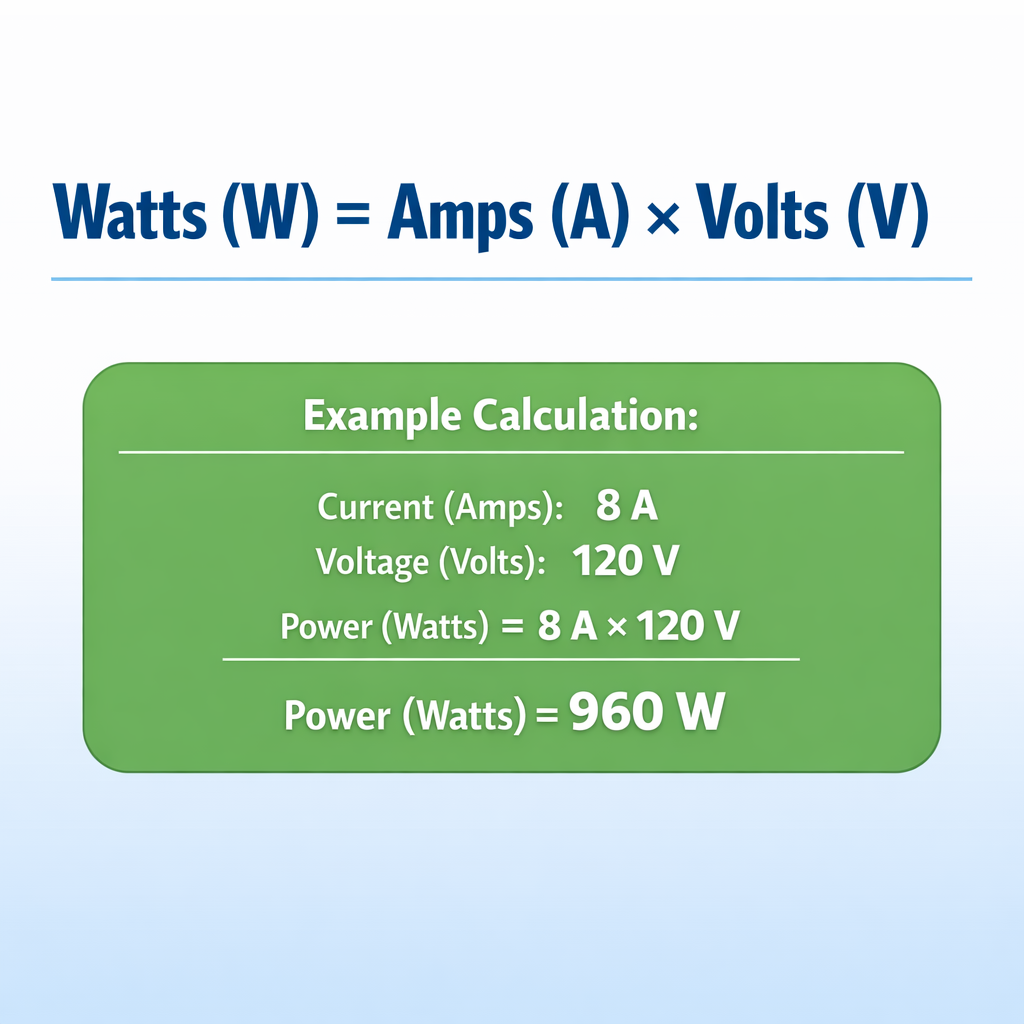
The fundamental relationship is P = V × I — power equals voltage times current. The formula adapts slightly for AC circuits where power factor comes into play, and for three-phase where the √3 geometry factor appears.
DC Circuits
DC has no power factor — every amp delivers its full share of power. A 24 V DC power supply delivering 5 A outputs 24 × 5 = 120 W. This formula covers batteries, solar panels, automotive systems, and any DC source.
Single-Phase AC
In single-phase AC, the power factor determines how much of the apparent power does useful work. A 120 V circuit carrying 15 A with PF = 1.0 delivers 120 × 15 × 1.0 = 1,800 W. But if the load is a motor with PF = 0.80, the real power drops to 120 × 15 × 0.80 = 1,440 W — 360 W less useful output even though the breaker sees the same 15 A. This distinction matters for energy billing and load scheduling.
Three-Phase AC
For three-phase, V is the line-to-line voltage (480 V, 400 V, 208 V). The √3 factor (≈ 1.732) captures the geometric advantage of three conductors with 120° phase offsets. A 480 V feeder drawing 30 A at PF = 0.85 delivers 480 × 30 × 1.732 × 0.85 = 21,198 W (21.20 kW). These standards are defined by IEEE and IEC 60038 for global consistency.
The watts formula in plain English
Think of it this way: amps tell you how much current flows, volts tell you the pressure pushing it, and watts tell you the work being done. Multiplying amps by volts gives you the total electrical flow (apparent power). The power factor then adjusts that number to reflect only the useful portion (real power). For simple resistive loads — heaters, incandescent lights, kettles — PF is 1.0, so watts equals volts times amps exactly. For anything with a motor, compressor, or electronic power supply, PF is less than 1, and the real watts are lower than the volts-times-amps number.
Watts vs Amps — Understanding the Difference
Many people confuse watts and amps because they both describe electricity, but they measure fundamentally different things. Here is a direct comparison:
| Characteristic | Ampere (A) | Watt (W) |
|---|---|---|
| What it measures | Electric current (flow rate) | Power (rate of energy use) |
| SI status | Base unit (one of 7) | Derived unit (kg·m²·s⁻³) |
| Depends on voltage? | No | Yes — W = V × A |
| Used to size | Wires, breakers, fuses | Appliances, generators, utility bills |
| On an appliance label | Sometimes (nameplate FLA) | Almost always (wattage rating) |
| On your electricity bill | No | Yes (as kWh = kilowatt-hours) |
| Affected by PF? | No | Yes — real watts drop when PF drops |
The critical practical takeaway: 15 amps at 120 V is only 1,800 W, but 15 amps at 240 V is 3,600 W — double the power for the same current. This is why higher-voltage systems use thinner wire for the same wattage, and why industrial installations prefer 480 V or 600 V to reduce conductor cost and voltage drop.
Watts to Amps — Inverse Conversion
To reverse the conversion, divide instead of multiply:
| Watts | Amps @ 120 V | Amps @ 220 V | Amps @ 240 V |
|---|---|---|---|
| 500 | 4.17 | 2.27 | 2.08 |
| 1,000 | 8.33 | 4.55 | 4.17 |
| 1,500 | 12.50 | 6.82 | 6.25 |
| 2,000 | 16.67 | 9.09 | 8.33 |
| 3,000 | 25.00 | 13.64 | 12.50 |
| 5,000 | 41.67 | 22.73 | 20.83 |
| 10,000 | 83.33 | 45.45 | 41.67 |
For the full inverse tool, check our dedicated Amp to kW Calculator which converts from current to kilowatts directly.
Solved Examples — 6 Real-World Cases
Example 1 — 1 Amp USB Charger (5 V DC)
Data: Phone charger, 5 V DC output, 1 A.
Formula: W = V × A = 5 × 1 = 5 W
A standard USB port delivers 5 W. Fast chargers push 2–3 A at 5 V (10–15 W) or use higher voltages (9 V, 12 V, 20 V) to reach 25–65 W.
Example 2 — 5 Amps on a 120 V Circuit
Data: Table fan drawing 5 A, 120 V, PF = 0.90.
Formula: W = 120 × 5 × 0.90 = 540 W
A large box fan or small window AC. With PF = 1.0, the result would be 600 W — but the motor’s reactive power reduces the useful output to 540 W.
Example 3 — 10 Amps on a 240 V Circuit
Data: Portable room heater, 10 A, 240 V, PF = 1.0 (resistive).
Formula: W = 240 × 10 × 1.0 = 2,400 W
A 2.4 kW heater on a 240 V circuit — common in the UK and Australia. At 120 V the same heater would need 20 A, doubling the wire and breaker size required.
Example 4 — 32 Amps on a 220 V Circuit
Data: EV home charger (EU), 32 A, 220 V, PF = 1.0.
Formula: W = 220 × 32 × 1.0 = 7,040 W
A 7 kW EV charger adds about 35–45 km of range per hour. This is the most common Level 2 configuration in Europe, running on a dedicated 32 A MCB (miniature circuit breaker).
Example 5 — 20 Amps Three-Phase (480 V)
Data: Industrial ventilation fan motor, 20 A, 480 V 3Φ, PF = 0.84.
Formula: W = 480 × 20 × 1.732 × 0.84 = 13,969 W
About 14 kW — a medium HVAC supply fan. The three-phase advantage is clear: a single-phase 480 V circuit at 20 A would only deliver 8,064 W, barely half the power.
Example 6 — 15 Amps on a Standard US Branch (120 V)
Data: General-purpose 15 A circuit, 120 V, PF = 1.0.
Formula: W = 120 × 15 × 1.0 = 1,800 W
The theoretical maximum of a 15 A / 120 V branch. NEC 210.23(A) caps continuous loads at 80% = 12 A = 1,440 W. A 1,500 W space heater plus a 200 W lamp would overload this circuit at 1,700 W total.
Amps to Watts in Electric Motors — Input vs Output Power
Electric motors are the most important real-world application of the amps-to-watts conversion because the nameplate amps and the useful watt output are always different. The difference comes from efficiency losses and power factor.
For example, a 3-phase, 10 HP motor at 480 V draws 14 A at full load. With PF = 0.84 and efficiency = 0.91: W input = 480 × 14 × 1.732 × 0.84 = 9,779 W. Shaft output = 9,779 × 0.91 = 8,899 W ≈ 11.9 HP — slightly above the 10 HP rating because manufacturers derate the nameplate conservatively.
Lightly loaded motors (below 40% rated load) have significantly lower PF — sometimes 0.40–0.55. At that PF, the amps-to-watts conversion still gives you the real input watts, but a large portion of the current is reactive (it flows back and forth without doing work). Energy audits use clamp-on power meters to measure actual amps and PF, convert to watts, and identify motors that should be downsized. Per NEMA MG-1, replacing an oversized motor with a properly sized premium-efficiency motor can cut energy use by 10–25%.
During startup, induction motors draw 6–8× their full-load amps (locked-rotor current). However, because the PF during starting is very low (0.15–0.25), the actual watts consumed during the few seconds of starting are much less dramatic than the amperage spike suggests. This is why properly rated inverse-time breakers don’t trip during normal motor starting.
Quick Equivalences — Amps to Watts
Direct answers for the most searched amps-to-watts values. All results use PF = 1.0 (resistive loads) unless noted. For motor loads, multiply by 0.80–0.85 to account for PF.
1 Amp to Watts
120 W at 120 V · 220 W at 220 V · 240 W at 240 V
1 amp equals a different wattage at every voltage — there is no fixed conversion without knowing the voltage.
5 Amps to Watts
600 W at 120 V
1,100 W at 220 V · 1,200 W at 240 V. A medium-sized appliance like a blender or box fan.
10 Amps to Watts
1,200 W at 120 V
2,200 W at 220 V · 2,400 W at 240 V. A large toaster, space heater, or iron.
15 Amps to Watts
1,800 W at 120 V
Max capacity of the standard US 15 A residential circuit. Practical limit (NEC 80%) is 1,440 W continuous.
20 Amps to Watts
2,400 W at 120 V
4,800 W at 240 V. Standard for dedicated kitchen and bathroom circuits per NEC.
32 Amps to Watts
7,040 W at 220 V
7,680 W at 240 V. Standard EU EV charger or induction cooktop circuit (32 A MCB).
30 Amps to Watts
7,200 W at 240 V
Standard US circuit for water heaters and dryers. A 4,500 W elem
ent uses 18.75 A of the 30 A capacity.50 Amps to Watts
12,000 W at 240 V
Electric range or Level 2 EV charger. At continuous load (80% NEC), usable capacity is 9,600 W.
100 Amps to Watts
24,000 W at 240 V
Total capacity of a 100 A residential service. Most homes with this panel peak around 10–15 kW.
200 Amps to Watts
48,000 W at 240 V
Standard modern US residential main. A 22 kW standby generator covers typical peak demand on this service.
Frequently Asked Questions
How do you convert amps to watts?
Multiply amps by volts: W = V × A. For AC circuits, include the power factor: W = V × A × PF. For three-phase, add the √3 factor: W = V × A × 1.732 × PF. Use the calculator at the top for instant results.
How many watts is 1 amp?
120 W at 120 V, 220 W at 220 V, or 240 W at 240 V. There is no single answer — watts always depend on voltage. The formula is W = V × A.
How many watts is 32 amps at 220 V?
7,040 watts. Calculation: 220 × 32 = 7,040 W. At 240 V it becomes 7,680 W. This is the standard rating for EU EV chargers and large cooking appliances.
How many watts is 10 amps at 120 V?
1,200 watts. Calculation: 120 × 10 = 1,200 W. Roughly the draw of a medium space heater or a large toaster.
What is the watts formula?
W = V × A for DC and simple AC. The extended formula is W = V × A × PF, where PF is the power factor (1.0 for resistive loads, 0.80–0.90 for motors). This is derived from the fundamental power equation P = V × I defined in electrical engineering standards.
What is the amps formula?
A = W ÷ V for DC. For single-phase AC: A = W ÷ (V × PF). For three-phase AC: A = W ÷ (V × √3 × PF). This is the inverse of the watts formula, rearranged to solve for current.
How many watts is 5 amps at 120 V?
600 watts. Calculation: 120 × 5 = 600 W. This is typical for a box fan, a blender, or a few LED light fixtures on one circuit.
Is 15 amps a lot?
At 120 V, 15 A = 1,800 W — the full capacity of a standard US branch circuit. A single 1,500 W space heater uses 12.50 A of that, leaving only 2.50 A (300 W) for anything else on the same breaker.
Can I convert amps to watts without voltage?
No. Watts equals amps times volts, so without the voltage you cannot calculate power. If you don’t know the voltage, check the nameplate on your appliance or the marking on the outlet. Common values: 120 V (US), 220–240 V (EU, Asia, South America), 100 V (Japan).
How many watts does a 200-amp panel supply?
48,000 watts (48 kW) at 240 V with PF = 1.0. In practice, residential PF is about 0.90, so usable power is around 43 kW. Most homes never draw more than 20–25 kW simultaneously.
Why do motors draw more amps than the watts suggest?
Because motors have power factor less than 1 (typically 0.75–0.90). The total current includes reactive amps that flow back and forth without doing work. The real watts (useful output) are lower than V × A. For example, a motor drawing 10 A at 240 V with PF = 0.80 uses only 1,920 W of real power, not the 2,400 W that V × A implies.
How do I convert 32 amps to watts for a three-phase circuit?
At 400 V 3Φ with PF = 0.85: W = 400 × 32 × 1.732 × 0.85 = 18,852 W (18.85 kW). At 480 V with the same PF: W = 480 × 32 × 1.732 × 0.85 = 22,622 W. The higher voltage and three-phase geometry deliver significantly more power from the same 32 A of current.
Related Conversions
Explore more electrical conversion calculators on our site:
- Amp to kW Calculator — convert amperes to kilowatts with voltage and PF.
- Amperes to VA Calculator — amps to volt-amperes for transformer and UPS sizing.
- Amperes to Resistance (Ohm’s Law) Calculator — find ohms from current and voltage.
- Amps to HP Calculator — convert amperage to motor horsepower.
- Motor Efficiency Calculator — calculate input vs output power and losses.
- AWG to mm² Equivalences — wire gauge cross-reference for conductor sizing.